If you work with multiple B.V.’s or legal entities, this comes up sooner or later: someone from another company within the group contributes to a project. Whose hour is it, at what rate does it go out the door, and on whose invoice does it end up?
The problem
One project, multiple companies
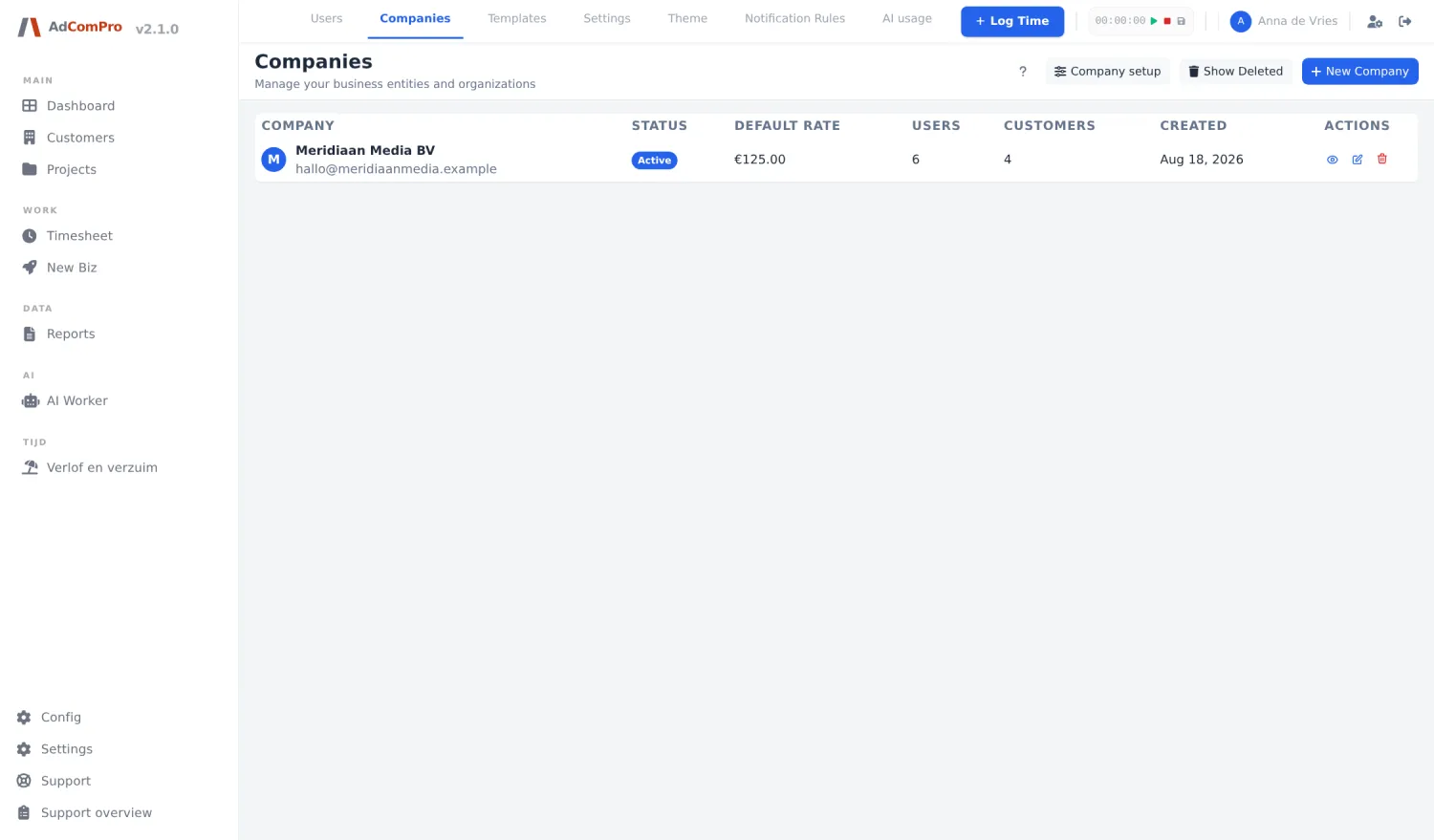
Most systems assume a single company. There is one timesheet, one rate and one invoice. As soon as your group consists of multiple entities, you have to solve that by hand: retyping hours, creating a separate invoice, and hoping it still adds up at the end of the quarter.
The result is familiar. Hours nobody cross-charges because they fell between two stools, or an intercompany settlement that only surfaces at the annual accounts.
How AdComPro does it
People from different companies on one project
In AdComPro a project team can consist of people from different entities, each with their own permissions within that project. Everyone simply logs hours on the task they are working on; the system knows which company that person belongs to.
What that gets you
- Everyone works in the same project, without duplicate administration per company
- The rate follows the person and the level they log on, not one fixed amount for the whole project
- Cross-charging between your own entities is part of invoicing, not manual work afterwards
- VAT and discount can be set separately per invoice line
Because the hours are attached to the right company from the start, there is nothing to untangle at the end of the month. The cross-charge follows from what was logged.
Questions
What people ask about this
Can someone work in multiple companies?
Yes. A contact can belong to multiple companies, one of which counts as the primary relationship. In a project team you can include people from different entities, each with their own permissions.
What if the rate differs per company?
Rates are set at four levels: task, milestone, project and company. The most specific level wins, so an exception in one place doesn’t mean going through all the time entries.
Can I see who changed what?
Yes. Every change is recorded with the old value, the new value, who made it and from which IP address. In a dispute over a cross-charge, that is the difference between proving and assuming.
Try it yourself
Run a month through it
Set up a project with people from two companies and see what the cross-charge looks like before you invoice anything.