AdComPro editorial team · 27 September 2026
The client pays a fixed monthly amount. September is quiet; in October everything becomes urgent. Then comes the question: ‘Didn’t we have some budget left from last month?’ Retainers work well when both sides understand what is being bought and what an unused balance means. Without that clarity, a convenient agreement can become a recurring discussion.
In this guide
- Define what the client is buying
- Show how the balance moves
- Avoid a balance your schedule cannot deliver
- Keep each period recognisable
- Use the monthly conversation to set expectations
- Checklist for the next retainer
Define what the client is buying
A retainer can cover reserved capacity, a number of hours, a monetary budget or a defined package of services. These are different agreements. A €3,000 monthly payment does not by itself explain how many hours are available or which activities are included. Define the unit you measure, the rates that apply and how additional work is discussed.
Keep money and time distinct. If specialists have different rates, €500 of remaining budget does not always buy the same number of hours. Avoid silently turning a cash balance into a promise of time. The explanation of different hourly rates helps you apply the agreement consistently. The contract model determines how to interpret the budget figures.
Show how the balance moves
Consider a fictional agreement that allows all unused monetary budget to carry into the next month. Each month adds €3,000. Spending below means the amount charged against the budget under that agreement; it is not the internal labour cost of delivering the work.
| Period | Opening balance | New budget | Spending | Closing balance |
|---|---|---|---|---|
| September | €0 | €3,000 | €2,400 | €600 |
| October | €600 | €3,000 | €3,200 | €400 |
| November | €400 | €3,000 | €3,500 | −€100 |
The calculation is opening balance plus new budget minus spending. A negative €100 balance calls for a decision under the agreement; it does not automatically authorise an extra invoice. Expiring budgets, balance caps and fixed hour allowances produce different results. Explain the rules before presenting the total.
Avoid a balance your schedule cannot deliver
A carried-over budget does not create unlimited team availability when the client wants to use it. If five clients spend their accumulated balances at the same time, capacity may still be tight. Discuss both the financial balance and the work expected in the next period.
Choose a workable arrangement together: unlimited rollover, a capped balance, use within a defined period or a scheduled review. The right approach depends on the service and the agreement. Clarify who schedules work and how much notice a larger assignment needs. The balance is an administrative figure; the delivery schedule still needs a conversation.
Keep each period recognisable
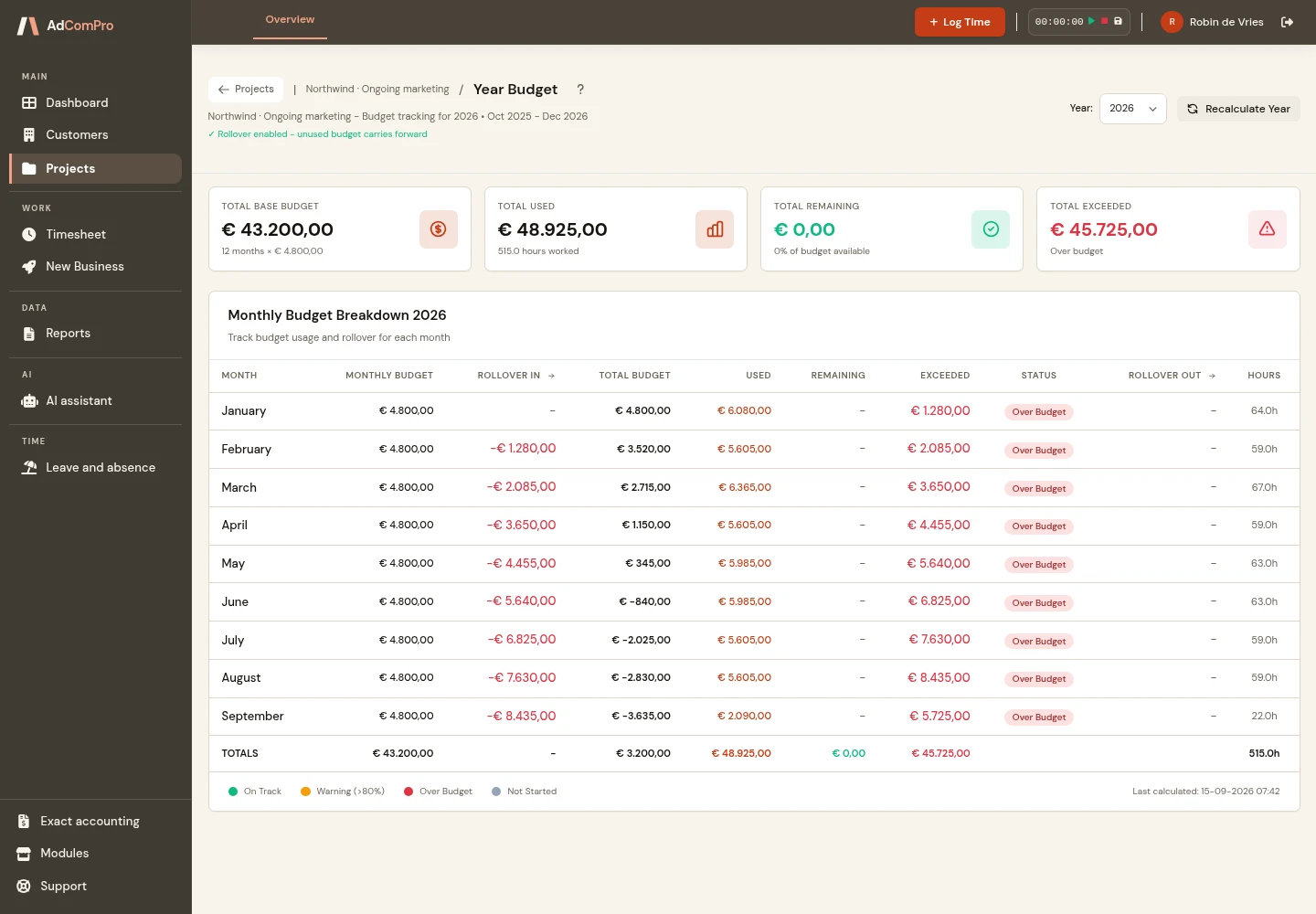
Ask people to record time against the correct month’s work. An entry in the wrong period changes the picture for two months at once. With automatic retainer renewal, the next project period is prepared in advance, making it easier to put time in the right place.
AdComPro supports retainer budget rollover alongside recorded time and costs. Check that your setup matches the agreement. A software calculation does not decide what you promised commercially. If you agree a cap or expiry rule, also decide how it will be monitored and discussed rather than assuming every custom rule is enforced automatically.
Use the monthly conversation to set expectations
Bring three things to the review: the balance, the work delivered and the work planned next. Discuss an expected shortfall before it occurs. If a surplus keeps growing, ask whether the package is too large, work is being postponed or the available service is not being used.
A positive client budget can still accompany an unattractive project contribution if delivery consumes too much internal time. Keep project profitability separate from the client’s available budget. One measures what the assignment contributes to the agency; the other describes room remaining under the client agreement. They answer different questions.
Checklist for the next retainer
- State whether the agreement concerns money, hours, capacity or deliverables.
- Define how positive and negative balances are treated.
- Schedule a joint review of budget, workload and scope.
- Record work by period and check entries before closing it.
- Clarify how a remaining balance is handled when the agreement ends.
To close the billing loop as well, read how to find unexplained differences between hours and invoices. Still deciding on the commercial model? Compare fixed-price work, hourly billing and retainers.
Keep reading
- How to calculate project profitability: busy does not mean profitable
- Worked but not billed: how to find the missing hours
- Fixed price or hourly rate: choose the agreement that fits the work
Put the ideas into practice
Choose one familiar project to try this approach. Explore the interactive demo, browse the features or start a free trial month.