AdComPro editorial team · 27 September 2026
A quick change on Friday afternoon. An extra client call on Monday. At month-end, neither appears on the invoice. Often the problem is not dramatic: there is simply no clear handoff between doing the work, recording it, reviewing it and billing it. A repeatable routine makes it easier to see where time is getting stuck.
In this guide
- Unbilled does not always mean forgotten
- Check four handoffs
- Make the gap visible with a small example
- Make month-end smaller and more predictable
- Build the invoice from reviewed records
- A fifteen-minute review with three questions
Unbilled does not always mean forgotten
Start by separating different situations. Some time is deliberately non-billable: business development, internal work or a service you choose to include. Other hours belong to a fixed-price project or retainer and should not appear as extra hourly charges. Sometimes you agree to invoice a particular item later.
The useful question is not how to turn every hour into an invoice line. It is whether every entry has an explainable outcome. Make non-billable work, pending approval and deliberately postponed billing distinguishable. Otherwise a valid exception and an administrative mistake end up in the same pile, and nobody knows which one needs action.
Check four handoffs
- Work to time entry: is the activity recorded against the right client project and period?
- Entry to approval: does someone own the review of outstanding hours?
- Approval to draft invoice: are the hours and costs intended for this billing cycle included?
- Draft to sending: has the invoice been checked, finalised and actually sent?
Give each step an owner. In a small agency the same person can cover several steps, but the handoff should still be clear. Time tracking with approval helps distinguish an entered hour from one that has been reviewed. A queue without an owner tends to become next month’s queue.
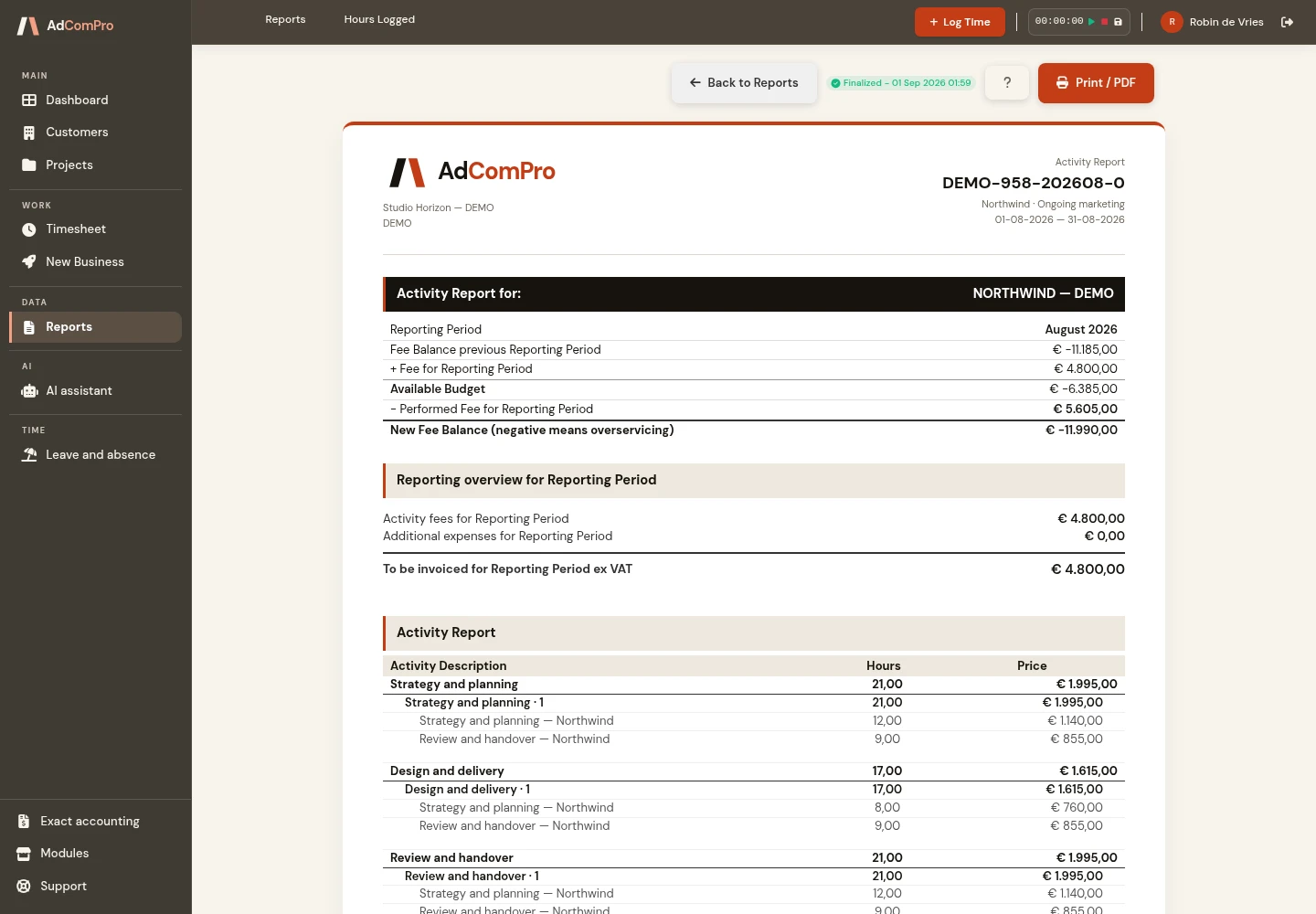
Make the gap visible with a small example
A team has 80 approved hours that are billable under the client agreement. The draft invoice contains 72 hours. Six hours have been deliberately postponed to the following month. There is no explanation for the remaining two.
| Check | Hours |
|---|---|
| Approved and intended for billing | 80 |
| Included in the draft invoice | 72 |
| Deliberately postponed and documented | 6 |
| Unexplained difference | 2 |
At an agreed rate of €100 per hour, those two hours represent €200 of potential billing value, excluding VAT. That is not proven lost revenue. First check that the entries are correct, have not already been included elsewhere and are covered by the client agreement. This review protects against both forgotten work and duplicate billing.
Make month-end smaller and more predictable
Ask people to complete their timesheets during the week and schedule a review before the billing run. ‘Miscellaneous’ is difficult to explain a month later. ‘Second revision of campaign landing page’ gives the project lead something useful to check. Record why an entry is rejected or postponed as well as what happened.
Then review exceptions by project. Is a rate missing? Is the task assigned to the wrong client? Is an expense waiting for approval? Compare the same period, projects and statuses rather than unrelated monthly totals. Consistent agency time tracking reduces the detective work at the end of the month.
Build the invoice from reviewed records
In AdComPro, a draft invoice is built from approved hours and costs, grouped by milestone or task. While it remains a draft, the lines can be checked and adjusted. If a line moves to the following month, give that decision a clear reason and an owner who checks that it returns.
Follow the complete time-to-invoice process. Check the hourly rates and the agreed billing model alongside the entries. Once the invoice is finalised, the accounting handoff is a separate step, for example through the Exact Online integration. Transferring an invoice does not by itself show that the client has paid it.
A fifteen-minute review with three questions
Which hours have not been submitted? Which submitted entries are waiting for review? Which approved services still lack a clear billing outcome? Keep a short exception list with a reason, an owner and a next action. Ten concrete actions are more useful than a large report that nobody follows up.
After a few cycles, check whether the same cause keeps returning. An unclear client agreement may be the real issue. The guide to fixed-price or hourly work helps clarify the billing model. To understand what the assignment earns after costs, combine this routine with project profitability analysis.
Keep reading
- How to calculate project profitability: busy does not mean profitable
- Unused retainer budget: roll it over or revisit the agreement?
- Fixed price or hourly rate: choose the agreement that fits the work
Put the ideas into practice
Choose one familiar project to try this approach. Explore the interactive demo, browse the features or start a free trial month.