AdComPro editorial team · 27 September 2026
‘What will it cost?’ It is a reasonable question, but not every assignment fits the same pricing model. A tightly specified brochure differs from a campaign whose direction is still emerging. Start with what you know about the work, who decides on changes and who carries the risk of additional hours. Clear project planning for agencies helps translate the pricing agreement into concrete work.
In this guide
- A fixed price buys an agreed outcome
- One price, two very different outcomes
- An hourly rate buys time under agreed conditions
- A budget limit brings the conversation forward
- Match the model to the assignment
- Turn the agreement into a workable project
A fixed price buys an agreed outcome
Fixed pricing works best when the deliverable is clear. Describe what you will create, what the client will provide and how many reviews or revisions are included. Define when a request becomes additional work. Otherwise ‘a website’ may mean something quite different to each side.
Within the agreed scope, the agency generally carries the risk of spending more time than expected. That makes time tracking useful even when hours are not billed separately. Use the records to learn and monitor delivery. A fixed fee is not a reason to stop measuring how much effort an assignment takes.
One price, two very different outcomes
Suppose an assignment earns €6,000. The internal cost rate is €50 an hour and direct external costs are €500. At 70 hours, the project contribution is €2,000. At 100 hours, it is €500. This fictional example excludes any unallocated overhead, so the contribution is not automatically net profit.
The client’s price did not change, but thirty extra hours made a considerable difference. Review the remaining work during delivery. Our guide to calculating project profitability explains the calculation. It makes the effect of an overly generous revision allowance visible without turning every conversation into an argument about minutes.
An hourly rate buys time under agreed conditions
Hourly billing suits work whose scope develops along the way, such as ongoing support or research. The client pays for time that is billable under the agreement, at the agreed rate. Decide how entries are recorded, which roles or tasks have different rates and how often progress is reported.
The client still needs predictability. Provide an estimate or range and agree when you will check in. A budget warning is not permission to keep working beyond the agreement. Configure exceptions through the rate hierarchy and use time approval to review entries before invoicing.
A budget limit brings the conversation forward
At €100 an hour, a €6,000 budget provides room for 60 hours, assuming the same rate applies and no other costs are charged against that budget. After 45 hours, the team estimates another 20 hours to finish. The forecast is now 65 hours, or €6,500.
Discuss that forecast before doing the remaining work. You could reduce scope, change priorities or seek agreement for an extension. The appropriate choice depends on the client agreement. Tracking is useful because it gives you time to choose, not merely because it explains an unexpected invoice afterwards.
Match the model to the assignment
| Situation | Possible model | Key agreement |
|---|---|---|
| Clear deliverable, limited changes | Fixed price | Scope, revisions and additional work |
| Scope develops during delivery | Hourly billing | Rates, visibility and budget reviews |
| Recurring monthly support | Retainer | Included work and treatment of balances |
You can also split the assignment into phases: a bounded discovery stage followed by a separate delivery agreement. State how each phase is billed. A mixed model helps only when everyone knows which rule applies to each part of the work.
For recurring work, read about unused retainer budget and rollover. Under any model, keep billing and payment separate in your thinking. An agreed instalment, a finalised invoice and money received are different parts of the administration.
Turn the agreement into a workable project
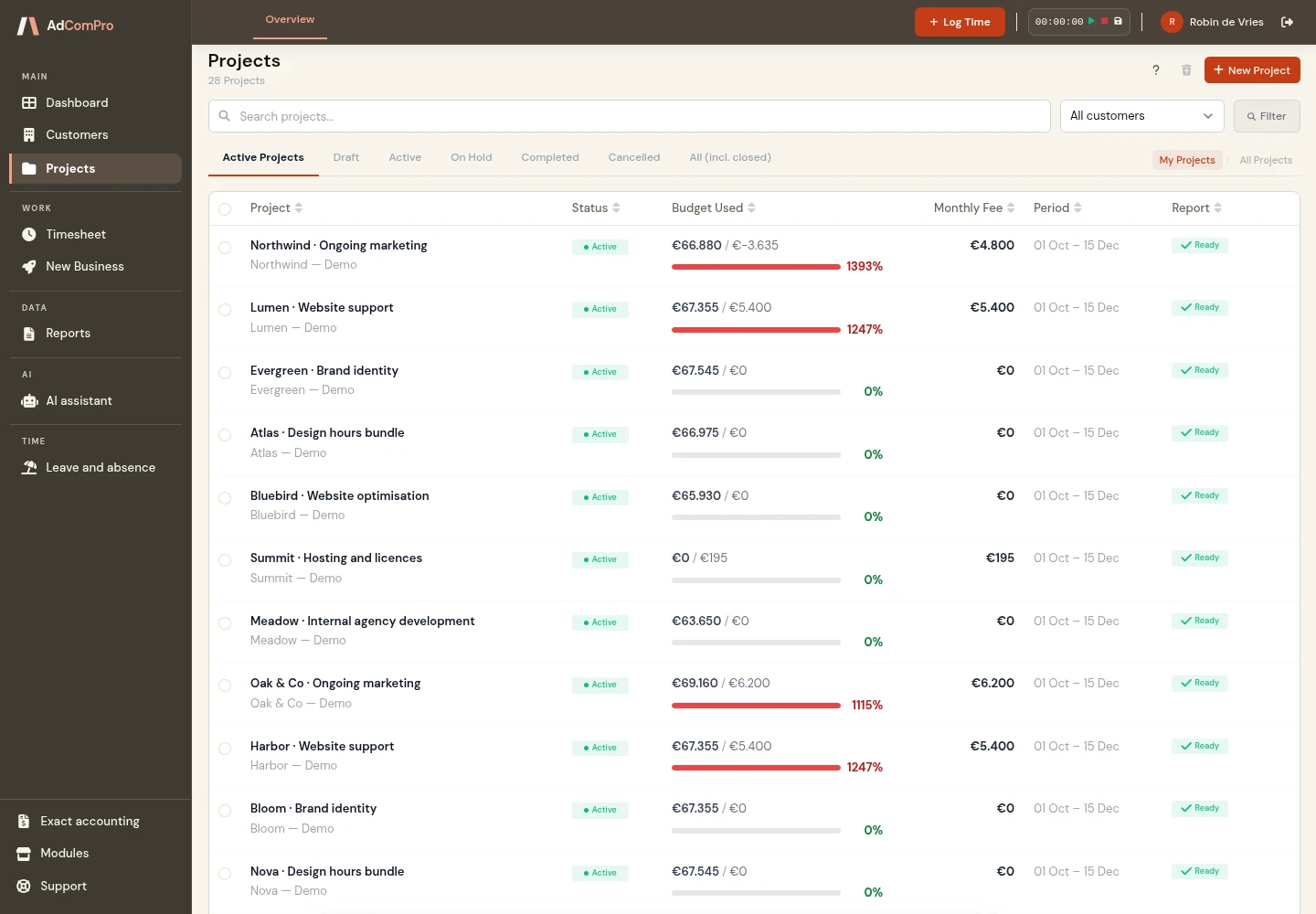
In AdComPro, choose a project type that matches the assignment, such as fixed price, time and materials or retainer. Break the work into milestones and tasks and check the pricing agreements before the team begins. The features overview shows how projects, time and invoicing fit together.
Then run a small example: record time, review it and check what moves towards an invoice. This exposes a setup mistake before an entire month is processed. Use the guide to invoicing recorded hours and the review of unbilled hours. A pricing agreement becomes useful when the team can apply it in everyday work.
Keep reading
- How to calculate project profitability: busy does not mean profitable
- Worked but not billed: how to find the missing hours
- Unused retainer budget: roll it over or revisit the agreement?
Put the ideas into practice
Choose one familiar project to try this approach. Explore the interactive demo, browse the features or start a free trial month.